
Apr
JAKOB RIIS. Estructura Propuesta Sonido. Music by Teresa Burga and Riis | INTONAL 2026
INTONAL 2026
Estructura Propuesta Sonido
Three works on the theme of registration as an aesthetic act: Pulse, message, and step trace a movement from the measured to the experienced, from structure to perception.
Teresa Burga’s Estructura Informe Corazón (de Autorretrato) (1972–2006) is based on the recording of the heartbeat as self-portrait. The heartbeat appears both as biological signal and as structural figure. In Burga’s work, the body is not a romantic symbol but a carrier of information. Data becomes form. Yet within this precise measurement an intense intimacy emerges: the pulse is both number and life. In the Acousmonium setting, the rhythm of the heart expands into a spatial phenomenon, where the interior acquires architectural dimension.
In Mensaje 4 (de 4 Mensajes) (1974), the focus shifts from the body to transmission. The voice appears as signal, as broadcast within a technological space. Communication is structured, fragmented, systemic. Burga’s method bears traces of musique concrète in its treatment of concrete sonic elements, but her distinctive hallmark is the insistence on registration. The status of sound as document remains audible; the structure stands clearly exposed.
Jakob Riis’ Step on, step in, step out (2026) draws on three years of pedometer data. The steps – thousands of daily movements – form the raw material of the work. The title suggests a passage through thresholds, while also pointing toward another impulse from Burga’s era, when consciousness itself was imagined as something that could be shifted, opened, expanded.
Here, the sober numbers of self-monitoring are displaced into a different register. What normally functions as a tool of control and health statistics is transformed into rhythmic flow and spatial experience. The step – a classic concrete sound object – detaches from its grounded function and begins to circulate within the loudspeaker space as a form of auditory passage. The data lose their linear direction and become movement within consciousness.
Teresa Burga (1935–2021) was a Peruvian artist and a central, though long overlooked, figure in Latin American conceptual art. From the late 1960s onward, she developed a practice that connected art, information, and social systems. Working with statistics, medical measurements, archives, diagrams, and institutional structures as artistic material, she investigated how identity and the body are shaped through registration and data. Her works often revolve around the self-portrait as informational structure and communication as a technologically and politically conditioned act. In recent years, her work has received broad international recognition and has been presented at major museums and biennials worldwide.
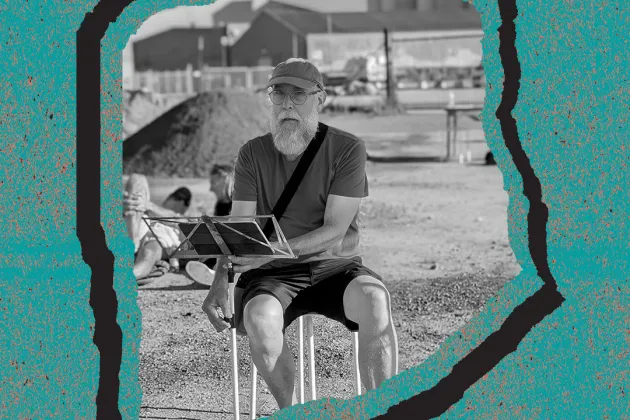
Jakob Riis (b. 1964) is a composer and sound artist who in recent years has focused on acousmatic music and spatial composition. His work explores how structures can be transformed into sensory experience within the loudspeaker space. Often combining electronic and concrete sound sources, he works from systemic points of departure that, through compositional processing, shift toward spatial and perceptual investigation. Riis’ works have been presented in concert and festival contexts, with particular emphasis on various multichannel formats.
About the event
Location:
Inter Arts Center, Bergsgatan 29, Malmö, 4th floor (Red Room)
Contact:
sylvia [dot] lysko [at] iac [dot] lu [dot] se